
Google changed how patients search for medical practices in March 2026. The update is called Ask Maps, and it runs inside Google Maps. Understanding what it does and what it requires from your practice is worth 10 minutes of your time right now.
This is not a minor interface tweak. It changes the criteria Google uses to decide which practices show up when someone is looking for exactly what you offer.
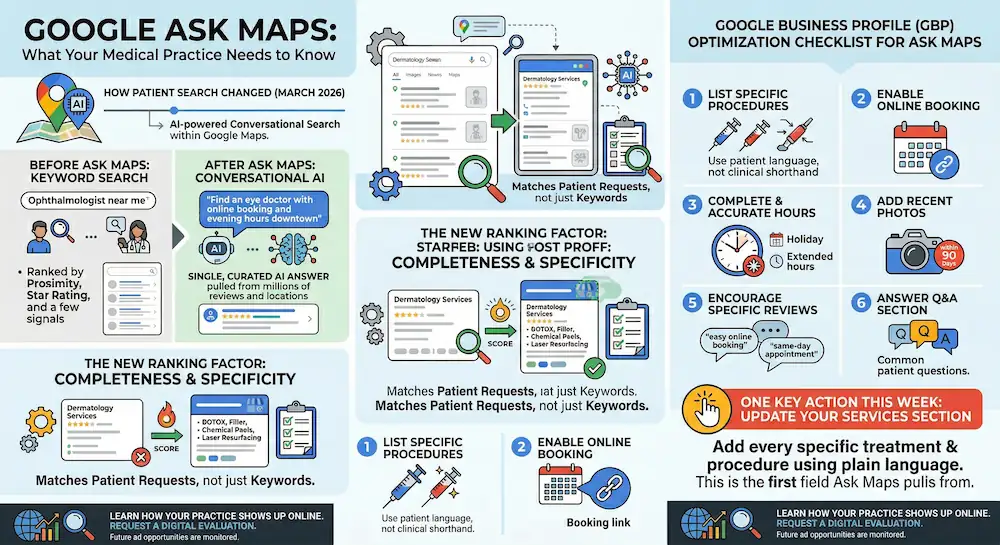
What Google Ask Maps Actually Does
Before Ask Maps, a patient typed “ophthalmologist near me” and got a list of results ranked by proximity, star rating, and a few other signals.
Ask Maps changes that. Now a patient can say “Find me an eye doctor that offers online booking and has evening hours downtown” and Google’s AI returns a single, curated answer pulled from over 500 million reviews and 300 million locations.
The AI matches the patient’s specific request, not just keywords. If your profile doesn’t clearly communicate that you offer online booking or evening hours, you don’t match. You don’t appear.
Why This Changes How Patients Find Your Practice
Google Maps has 2 billion monthly users. A meaningful portion of those searches are for local healthcare providers.
The old model rewarded proximity and star count. Ask Maps rewards completeness and specificity.
A practice that lists “dermatology services” and has 47 reviews competes very differently than a practice that lists “BOTOX, filler, chemical peels, laser resurfacing” with 180 reviews that mention specific treatments by name.
Ask Maps reads both. It returns the second one when the patient asks for what it describes.
This is not about gaming an algorithm. It’s about making sure the information patients are searching for is actually on your profile.

What Your Google Business Profile Needs Right Now
The practices that will surface in Ask Maps results are the ones with complete, specific profiles. Here is what that looks like in practice:
- Services listed by specific procedure. Not “aesthetic services.” List BOTOX, filler, microneedling, laser treatments — whatever you actually offer. Use the language your patients use, not clinical shorthand.
- Online booking enabled. If you offer it, link it. If it shows up on your profile, Ask Maps can include it as a reason to surface you.
- Hours accurate and complete. This includes holiday hours, extended evening hours, and any weekend availability. If someone asks for a practice with evening availability and yours shows 9-5, you won’t appear.
- Photos added within the last 90 days. Google uses photo recency as a freshness signal. An updated photo library signals an active, current practice.
- Reviews with specific language. You cannot write your own reviews, but you can ask patients to be specific when they leave them. A review that says “the online booking was easy and I got a same-day appointment” is more useful to Ask Maps than “great experience.”
- Q&A section answered. This is the most overlooked section of every Google Business Profile. Fill it out. Answer the questions your front desk hears every day.

The One Place to Start This Week
If you do one thing after reading this, update your services section.
Most practices list their specialties. Very few list their actual procedures. The services section is the field Ask Maps pulls from first, and it is the field most practices leave half-finished.
Log into your Google Business Profile, go to Services, and add every specific treatment and procedure you offer. Use plain language. Be detailed.
That single update will do more for your Ask Maps visibility than anything else on the list.

What SILVR Is Watching
Google stated that ads inside Ask Maps are “not a current focus.” That language leaves room.
Paid visibility inside a conversational AI search feature on Google Maps could become a significant advertising opportunity, and Google doesn’t leave those on the table for long. Practices that build strong organic presence inside Ask Maps now will have an advantage when paid options open up — whether that means lower competition, stronger quality scores, or simply being established before the cost of entry rises.
We are monitoring this closely and will update our clients as the product evolves.
Frequently Asked Questions
What is Google Ask Maps?
Ask Maps is a conversational AI feature inside Google Maps, launched in March 2026. It lets patients search using natural language, such as “Find me a med spa near me with evening hours and online booking,” and returns a single AI-generated recommendation based on hundreds of millions of reviews and business listings.
How does Ask Maps affect my medical practice?
It changes which practices appear when patients search. Ask Maps favors Google Business Profiles that are complete, specific, and current. Practices with sparse profiles — few services listed, outdated photos, no Q&A — will not surface in these results even if they rank well in traditional search.
What should I update on my Google Business Profile for Ask Maps?
Start with your services section. Add every specific procedure you offer using the language patients use. Then confirm your hours are current, enable online booking if you offer it, and add recent photos. Encourage patients to leave reviews that mention specific treatments or experiences.
Does Ask Maps affect all types of medical practices?
Yes. The impact is significant across specialties, but it is especially relevant for elective, aesthetic, and wellness practices where patients are actively comparing options and looking for specifics like booking availability, specific procedures, and practice experience rather than insurance coverage.
If you want to know exactly how your practice shows up across Google Maps, AI search, and your broader digital presence, that is the work we do at a Digital Evaluation.